How to Host a Poker Night That People Come Back To
I stopped playing baseball in 2007. I had played with the same group of men since 1991, and one by one they had gone — a knee, a job, a kid, the usual — until I looked up and found I was the last one still turning up. It was also the year I got divorced. It turned out I hadn’t only stopped playing baseball. I had stopped seeing anybody.
Then Brian called. He said: why don’t you come and play poker on Friday, at Jan’s? We all play, every Friday.
There was one problem. I didn’t know how to play poker. He said: no problem, man, I’ll teach you the basics and that’ll be enough. Two sessions. That was the entire education.
That game is still running. Everything below is what I learned from sitting at it, and from watching other people’s poker nights fall apart within a month.
Set the stakes so that losing is boring
Our buy-in was twenty francs. Blinds ten and twenty centimes. On my first Friday I walked out up about forty francs, which I took at the time as conclusive proof that I was the best player in the room.
I wasn’t. But the number is the point: at those stakes, nobody at that table could be hurt. That is the single most important decision you will make, and almost everyone gets it wrong by going too high.
The rule I’d give anyone starting a home poker game: pick a buy-in that the least wealthy person at the table would shrug off losing three weeks running. Not “can afford” — shrug off. A game where one person is quietly counting is a game that dies, and it dies without anyone saying why.
Fix the night, not the date
Ours is Friday. It has always been Friday. Nobody sends an invitation, nobody runs a poll, nobody negotiates. If it were arranged each week, it would have stopped in 2009.
Pick one recurring slot and let it be permanent. People who can’t make it don’t come — that is fine, a home game survives absences. What it does not survive is becoming a thing that has to be organised.
Six to eight, and always the same room
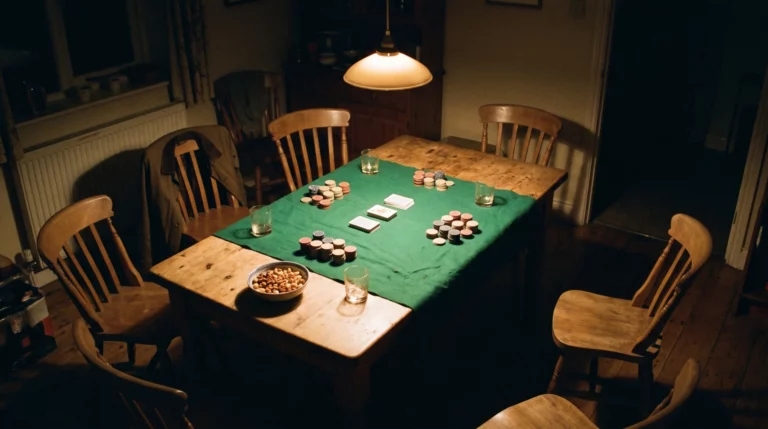
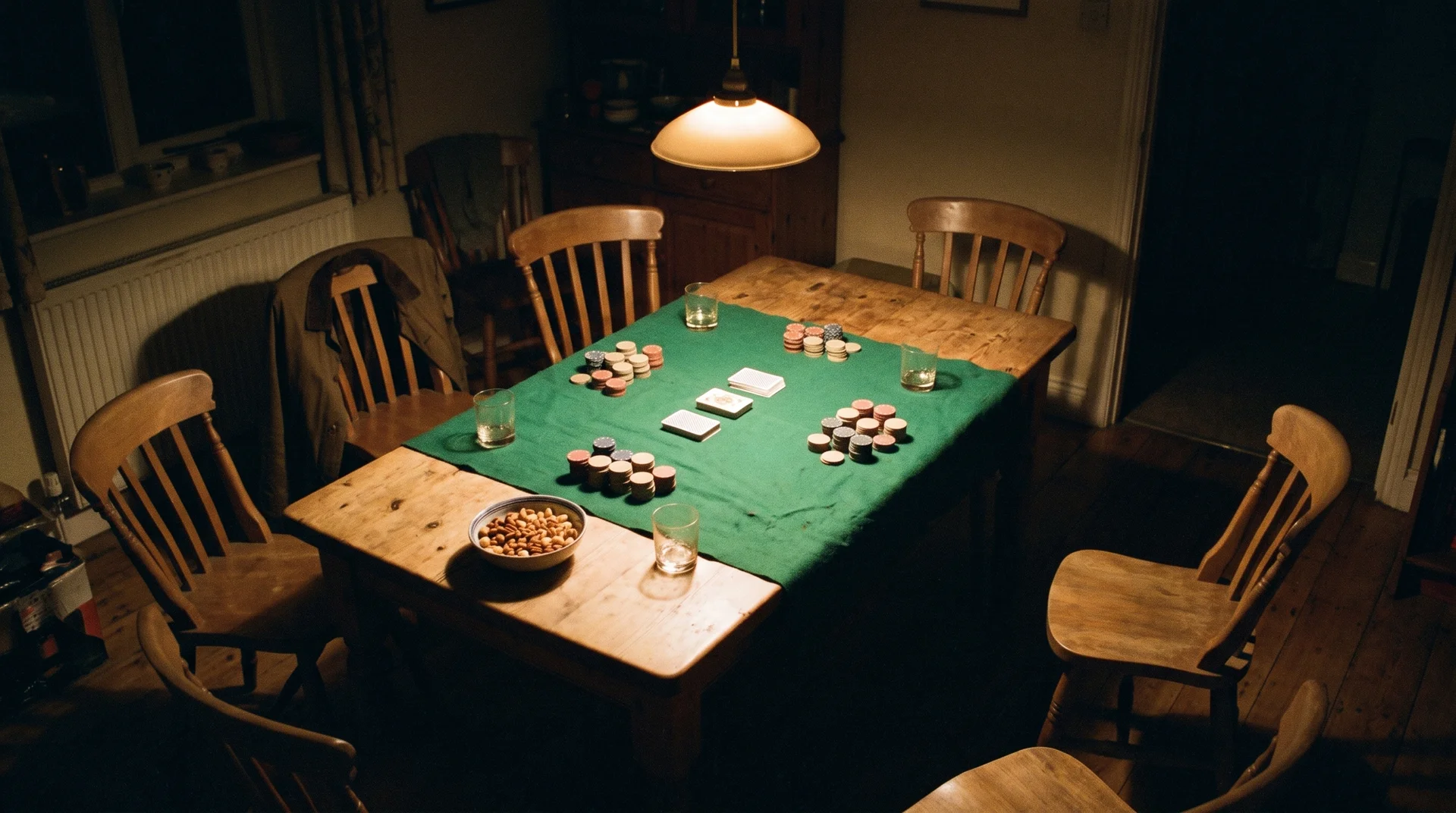
My first Friday there was Matt, Jan, Bruno, Fred — who everyone calls Grizzly — and one or two others I have since lost track of. Six or seven at a kitchen table is the shape that works. Five gets thin. Ten needs a second table and a different night.
Rotate the host if you must, but if you can help it, don’t. One room, one table, one set of chairs. The regularity is doing more work than you think.
What you actually need to run a poker night
Less than the internet will tell you.
- A cloth for the table. The cheapest thing on this list and the biggest difference. Cards slide instead of sticking, chips stop rolling onto the floor.
- Chips with some weight. Clay-composite over plastic. It is entirely about sound and feel, and both matter more than they should.
- Two decks. One in play, one being shuffled. It halves the dead time.
- A written structure, once. Blinds, buy-in, rebuys, when it ends. Agree it at the start and never discuss it again.
What you do not need: a branded table, a dealer button the size of a coaster, or a shuffling machine. Buy the cloth. If you are buying it for someone else’s table rather than your own, the same brief holds — it is the whole point of our guide to poker gifts for people who actually play.
Poker night snacks: keep one hand clean
The only rule worth having. Anything greasy ends up on the cards, and cards that have been handled with crisp fingers are cards you can read from across the table. Nuts, pretzels, olives, cured meat cut small, bread. Something that can be eaten with one hand and does not need a plate.
Serve it away from the felt if you can. A side table is a better investment than better snacks.
Teach the newcomer badly, on purpose
Brian gave me two sessions and told me that would be enough. He was right, and I think he knew he was being generous with the word “enough”.
If someone new is coming, do not hand them a strategy book. Teach them hand rankings, the order of betting, and what the blinds do. Everything else they will learn by losing twenty francs, which is a better teacher and a cheaper one. A newcomer who is drowning in theory does not come back. A newcomer who lost a bit and laughed does.
The part that is not about poker
I came back the second Friday, and I have kept coming back, and it was never really about the cards. The game had changed. The table hadn’t.
That is the thing a poker night is actually for, and it is why the advice above is mostly about stakes and scheduling rather than strategy. You are not building a game. You are building a standing reason for a group of adults to be in the same room every week, which turns out to be one of the harder things to arrange after thirty-five.
Get the buy-in low, get the night fixed, buy the cloth. The rest looks after itself.